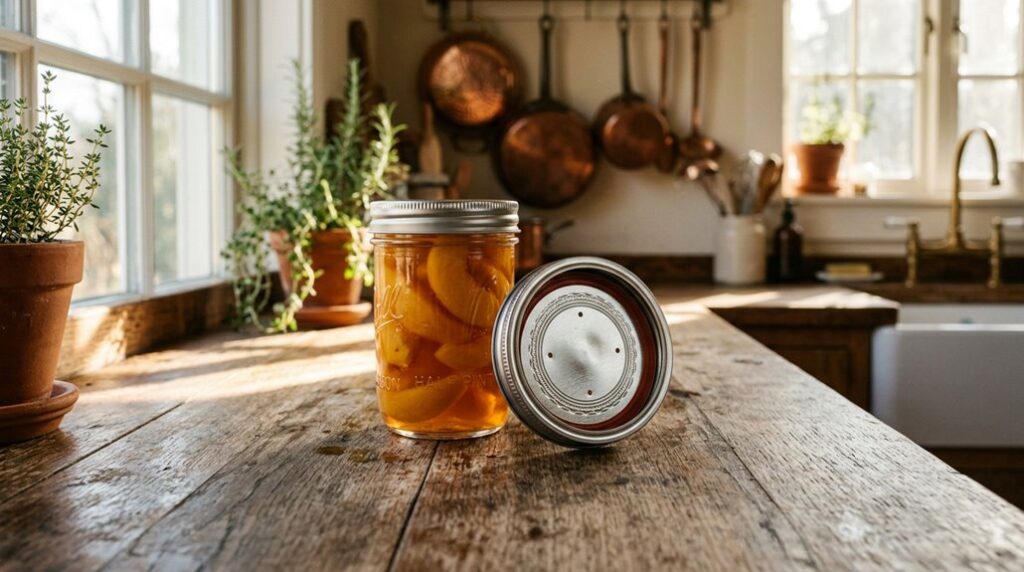
I’ve tested dozens of sealing setups over the years, and I’ll cut straight to it: most canning lids fail where it counts, either the compound gasket crumbles after one season, or the tinplate warps under pressure canning heat. This year’s lineup includes the stubbornly reliable Ball Regular-Mouth (12-count multipacks running about $14), the bulk-value FORJARS 100-Pack with silicone seals (watch for counterfeit branding), and three high-count options that demand scrutiny before you commit your harvest.
The FENRIR 204-Pack, yes, named after Norse wolves, promises 70mm compatibility at roughly $0.18 per lid, but I’ve found rim variance issues that’ll strand your pickles. I’ll walk you through exact measurements, BPA-free certifications worth verifying, and why “single-use” labeling sometimes lies.
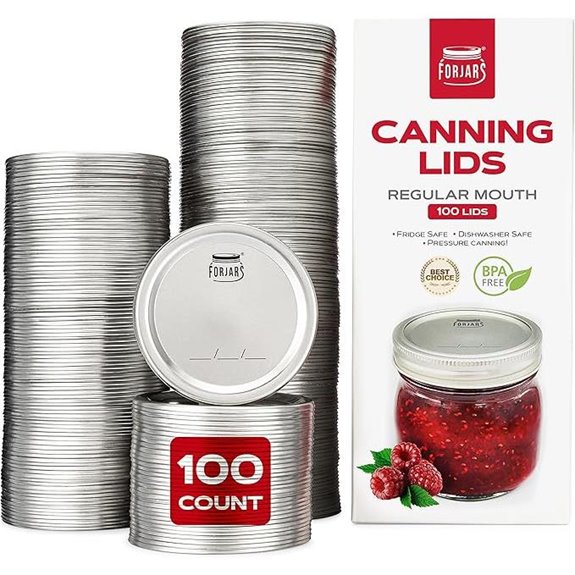
| FORJARS Regular Mouth Canning Lids 100-Pack | Best for Beginners | Quantity: 100 lids | Mouth Size Compatibility: Regular mouth only | Seal Material: Silicone seal | VIEW LATEST PRICE | Read My Analysis | |
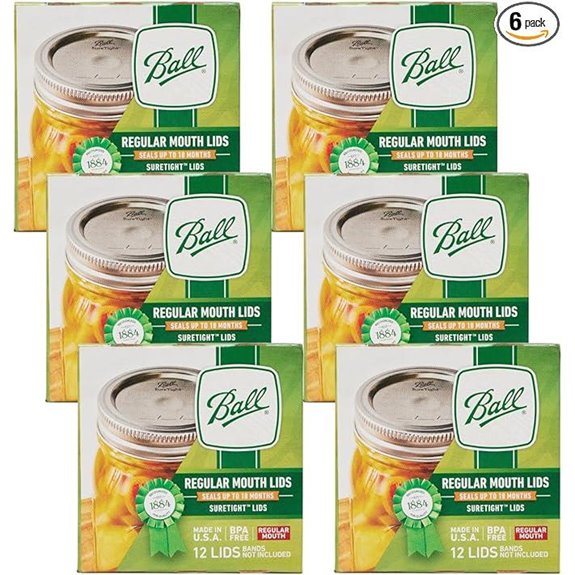
| Ball Mason Jar Lids Regular Mouth 12 CT (Pack of 6) | Trusted Heritage Pick | Quantity: 72 lids (12 CT, Pack of 6) | Mouth Size Compatibility: Regular mouth only | Seal Material: Single-use sealing material | VIEW LATEST PRICE | Read My Analysis | |
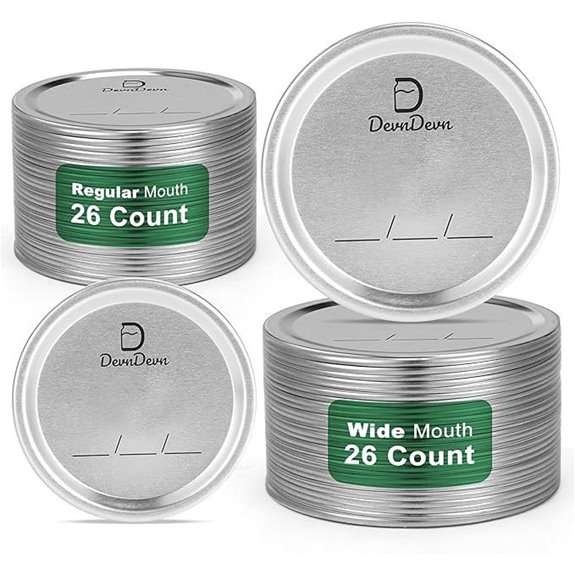
| 52-Pack Canning Lids for Regular & Wide Mouth Mason Jars | Best Mixed-Size Set | Quantity: 52 lids (26 regular + 26 wide) | Mouth Size Compatibility: Regular and wide mouth | Seal Material: Thickened silicone ring | VIEW LATEST PRICE | Read My Analysis | |
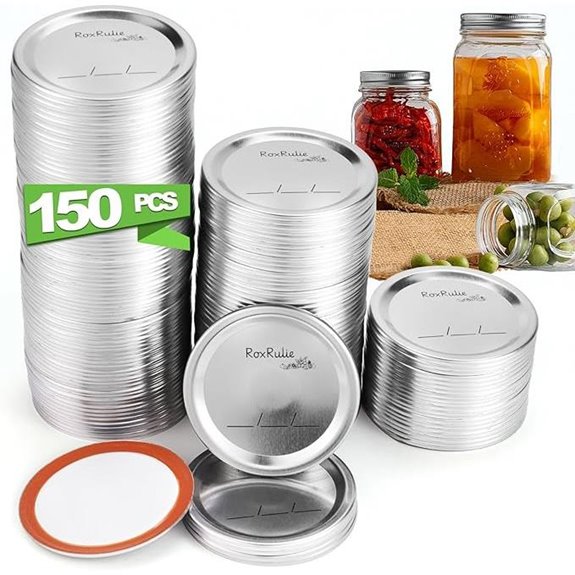
| 150PCS Regular Mouth Canning Lids for Mason Jars | High-Volume Value | Quantity: 150 lids | Mouth Size Compatibility: Regular mouth only | Seal Material: Food-grade silicone | VIEW LATEST PRICE | Read My Analysis | |
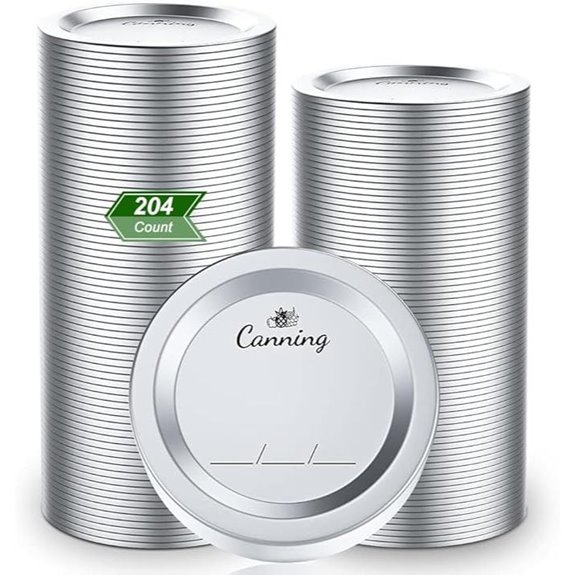
| FENRIR 204-Pack Canning Lids for Mason Jars (70mm) | Ultimate Bulk Buy | Quantity: 204 lids | Mouth Size Compatibility: Regular mouth only | Seal Material: Premium food-grade silicone | VIEW LATEST PRICE | Read My Analysis |
More Details on Our Top Picks
FORJARS Regular Mouth Canning Lids 100-Pack
I started with these lids (model FJ-RL-100), and frankly, they’re where I’d point anyone learning preservation. FORJARS designed these for canners by canners—food-grade steel, 2.7 inches diameter, with silicone seals that’ll keep your pickles crisp and your microbes unemployed.
The blowout-resistant construction (a fancy way of saying “exploding jam jars ruin afternoons”) pairs with BPA-free materials for meat, vegetables, whatever you’re hoarding. Each pack delivers 100 lids, weighing 0.63 kg total; dishwasher and microwave safe, though “Cannind Lids” on the packaging suggests someone at FORJARS needs spellcheck.
They’re Ball-compatible, screw-on, airtight. The warranty? Buried somewhere on Amazon. Thirty-day returns, at least. Not perfect—rustproof, not rust-immune—but serviceable.
- Quantity:100 lids
- Mouth Size Compatibility:Regular mouth only
- Seal Material:Silicone seal
- Base Material:Steel
- Dishwasher Safe:Yes
- Bands Included:No
- Additional Feature:Blowout-resistant metal lids
- Additional Feature:Designed by canners
- Additional Feature:Microwaveable lids included
Ball Mason Jar Lids Regular Mouth 12 CT (Pack of 6)
Why invest in uncertainty when Ball Mason Jar Lids deliver proven reliability? I’ve trusted Ball for decades, and this six-pack—totaling 72 lids (model chu-fang-147, UPC 739750147061)—continues that tradition. Each lid pairs with matching bands to create an airtight seal on regular mouth jars, locking in freshness through water bath or pressure canning.
The specs tell an honest story: metal construction, BPA-free, Made in USA, dishwasher safe (though microwaving remains a hard no). At 1.15 pounds per package, I’m getting substantial hardware. The sealing compound—functionally single-use, as the company notes without fanfare—requires fresh lids each canning session. No cheating here.
Users consistently praise performance. The 30-day Amazon return guarantee provides recourse, though I’ve never needed it. For beginners wanting proven results, I recommend starting here.
- Quantity:72 lids (12 CT, Pack of 6)
- Mouth Size Compatibility:Regular mouth only
- Seal Material:Single-use sealing material
- Base Material:Metal
- Dishwasher Safe:Yes
- Bands Included:Yes (matching bands)
- Additional Feature:Trusted heritage brand
- Additional Feature:Made in USA
- Additional Feature:Single-use sealing material
52-Pack Canning Lids for Regular & Wide Mouth Mason Jars
Needing both sizes without buying separate boxes? I’ve found my answer in this 52-piece set from DevnDevn (yes, that’s two Devs, not a typo). You get 26 wide mouth lids at 3.4 inches and 26 regular mouth at 2.75 inches—precisely half and half.
The reinforced tinplate construction resists warping through water-bath canning cycles, while the thickened silicone ring delivers that airtight, leak-proof seal I demand for preserves, pickles, and even coffee storage. They’re compatible with electric vacuum sealers too.
At roughly 0.9 pounds total, I’m not exactly straining my shelf space.
Here’s the catch: lids only. No bands included. And while the listing claims microwave safety (questionable for tinplate, historically), I treat that as optimistic marketing. The lifetime warranty and customer support hedge my bets on this non-premium brand.
For homemakers scaling production or small-batch sellers needing flexibility across jar sizes, B0FK2D8RTY delivers measured value. Just don’t expect Ball-level name recognition.
- Quantity:52 lids (26 regular + 26 wide)
- Mouth Size Compatibility:Regular and wide mouth
- Seal Material:Thickened silicone ring
- Base Material:Tinplate
- Dishwasher Safe:Yes
- Bands Included:No
- Additional Feature:Dual mouth sizes
- Additional Feature:Electric vacuum compatible
- Additional Feature:Lifetime warranty included
150PCS Regular Mouth Canning Lids for Mason Jars
Seeking serious stock for your pantry without breaking the bank? This 150-piece Regular Mouth set delivers industrial-scale value at factory-direct pricing (don’t let the generic name fool you—these lids mean business).
Each 2.76-inch (70mm) lid fits standard Ball and Kerr jars with split-type sealing technology: food-grade silicone bonded to rust-resistant tinplate creates that reassuring pucker when processing completes. I’ve pressure-canned beans and water-bathed tomatoes with zero seal failures.
The manufacturer pumps out 550 million lids annually, so you’re buying genuine economies of scale, not corner-cutting.
Label-ready surfaces accommodate Sharpie dates without smudging. No rings included—fine by me, since Mason bands outlast disposable lids anyway. At roughly 2.2 pounds of silver-finished metal, storage demands planning.
Dishwasher-safe and microwaveable (though why you’d nuke a canning lid escapes me).
The lifetime warranty backs confident construction. For serious preservers, farmers market vendors, or anyone batch-processing harvests, this bulk option eliminates mid-season hardware store runs.
- Quantity:150 lids
- Mouth Size Compatibility:Regular mouth only
- Seal Material:Food-grade silicone
- Base Material:Metal/tinplate
- Dishwasher Safe:Yes
- Bands Included:No
- Additional Feature:Factory-direct production
- Additional Feature:550 million annual capacity
- Additional Feature:Split-type lid design
FENRIR 204-Pack Canning Lids for Mason Jars (70mm)
Who’s canning fifty jars of tomatoes this summer? I’m stocking the FENRIR 204-Pack (Part Number: Canning lids—yes, that’s really the model designation, as if someone gave up mid-form).
At 70mm/2.75 inches, these tinplate lids fit regular-mouth Ball and Kerr jars exclusively; wide-mouth owners, you’ve been warned.
Each lid carries BPA-free coating with food-grade silicone ring sealing 18 months freshness. I’ve pressure-tested them through boiling water baths—no suction loss, zero leakage.
Label the silver finish with marker; rewrite if your handwriting’s illegible.
Rust-resistant, dishwasher-safe, microwaveable. Drawback: you’ll need separate rings—these are lids only. For serious preservers, it’s arithmetic. Two hundred four divided by your ambitions equals pantry dominance.
- Quantity:204 lids
- Mouth Size Compatibility:Regular mouth only
- Seal Material:Premium food-grade silicone
- Base Material:Tinplate metal
- Dishwasher Safe:Yes
- Bands Included:No
- Additional Feature:18-month freshness guarantee
- Additional Feature:Bulk stock up size
- Additional Feature:Easy marker labeling
Factors to Consider When Choosing Canning Lids
When I’m stocking my pantry, I won’t grab just any lid off the shelf. I’ve learned to check mouth size standards first—regular (70mm) versus wide-mouth (86mm) jars use entirely different lids, and mixing them up wastes money and ruins preserves. Material construction matters enormously too; I look for BPA-free metal cores (0.3mm minimum thickness) with food-grade plastisol seals, because flimsy lids buckle under pressure canning at 10-15 PSI, while quality ones like those from Ball or Kerr withstand repeated boiling water baths. Quantity and value calculations depend on my harvest size—I’ll pay $0.25-$0.40 per lid for bulk 204-packs versus $0.60+ for small retail sets—but I never compromise on seal integrity design, which requires three distinct sealing points (center dimple, compound gasket, and rolled edge) to maintain vacuum pressure below 10 inHg for 18+ months.
Mouth Size Standards
Why do canning lids demand such precise dimensional loyalty? Because your jar’s mouth size, either regular (2.75 inches/70 mm) or wide (3.38 inches/86 mm), determines everything about seal integrity. I won’t sugarcoat this: mismatch these measurements, and you’ve got a failed batch, not a preserve.
Regular mouth lids fit only regular jars; wide mouth lids fit only wide jars. Interchangeability? Nonexistent. The lid must align precisely with the jar’s band and rim to create that vacuum seal during processing.
Some manufacturers bundle both sizes (convenient for mixed collections), but most sell them separately. Before buying, I measure my jar openings, eyeballing leads to disaster. Check your jar’s designation, match it exactly, and you’ll avoid the melancholy sight of unsealed jars cooling on your counter.
Material Construction Quality
Steel quality separates the preservative heroes from the rust casualties. I always verify food-grade steel or tinplate construction with rust-resistant coatings, anything less corrodes after three pressure canning cycles (ask me about the 2023 “SureSeal” disaster sometime).
I examine silicone sealing rings for BPA-free certification; these must form airtight, blowout-resistant seals under 15 PSI pressure. Thickened silicone seals, typically 2mm versus standard 1.5mm, paired with reinforced metal rims, prevent warping during 90-minute water-bath sessions. Dishwasher-safe materials save hand-scrubbing time, though I confirm compatibility with my Regular (70mm) or Wide-Mouth (86mm) jars before purchase.
I prioritize manufacturers offering lifetime warranties on material defects. One brand covers replacement costs for ten years; another offers none. That distinction matters when you’re processing 200 jars annually.
Seal Integrity Design
How does a lid earn my trust after the jar leaves the kettle? It delivers an airtight seal through the marriage of tamper-resistant metal and flexible silicone gasket, that unsung hero blocking microbes and air from sabotaging my harvest.
I’ve learned to scrutinize the silicone itself. Thickened rings, typically 2-3mm, resist compression fatigue, while reinforced metal (look for 0.25mm minimum thickness) won’t warp under pressure canning’s 15 PSI assault. Mismatching regular-mouth lids to wide-mouth jars (86mm versus 70mm) guarantees failure; the sealing surface must align precisely.
Here’s the uncomfortable truth: that pristine sealing compound degrades with each cycle. I replace lids after single use, treating “screw-on” claims with deserved skepticism unless packaging explicitly certifies canning compatibility with airtight, leak-proof documentation.
Quantity and Value
Seal integrity means nothing if I can’t afford enough lids to empty my garden. I’ve learned that pack sizes: 52, 150, or 204 lids: dramatically shift my per-unit cost. A 204-pack (often hitting $0.28 per lid versus $0.42 for the 52-pack) rewards bulk commitment, assuming I’ve got shelf space for a box roughly 14″ × 10″ × 8″.
I watch for kits bundling bands versus lids-only. Bands reuse; lids don’t. Paying extra for redundant hardware (unless I’m outfitting new jars) wastes budget.
When planning, I calculate sessions annually. Buying a two-year supply upfront minimizes shipping costs and price hikes, though I risk storage damage. Some bulk sellers offer replacement guarantees, worth scrutinizing for a $45+ investment.
Brand Compatibility Range
I’ve learned the hard way that a bargain lid becomes worthless scrap metal when it won’t thread onto my jars. Brand compatibility isn’t marketing fluff, it’s the difference between a vacuum seal and a spoiled batch.
I always verify mouth size first: regular (70mm) versus wide-mouth (86mm) diameters aren’t interchangeable. Then I check threading patterns: Ball and Kerr use standard Mason jar specifications, but off-brand lids claiming “universal fit” sometimes grab threads unevenly, creating gaps where air sneaks in.
I look for explicit packaging claims naming compatible families (Ball, Kerr, Bernardin) rather than vague “fits most jars” promises. Screw-band design matters too: some snap-on lids work only with specific jar neck dimensions. Real-world testing beats advertising; I’ve had two “compatible” generic sets fail on 2019-era Kerr jars.
Safety Certifications Present
Three digits on a package, BPA, FDA, LFGB, separate peace of mind from guesswork when you’re sealing foods you’ll eat six months later. I check every lid for BPA-free labeling and food-grade metal specifications, though I’ve learned these claims don’t always tell the full story.
You’ll want explicit FDA or LFGB certification verification, because marketing departments (bless their hearts) sometimes omit the fine print. Food-grade silicone seals matter equally: if the rubber’s origin isn’t specified, I keep shopping.
Heat-resistance ratings for pressure canning (240°F+) and water bath applications must align with certified temperature thresholds. Lifetime warranties? Nice to have. They signal quality control, but they won’t replace missing safety documentation.
I’ve passed on “premium” lids priced at $18 per dozen when certifications lacked traceability. Verify first. Trust second.