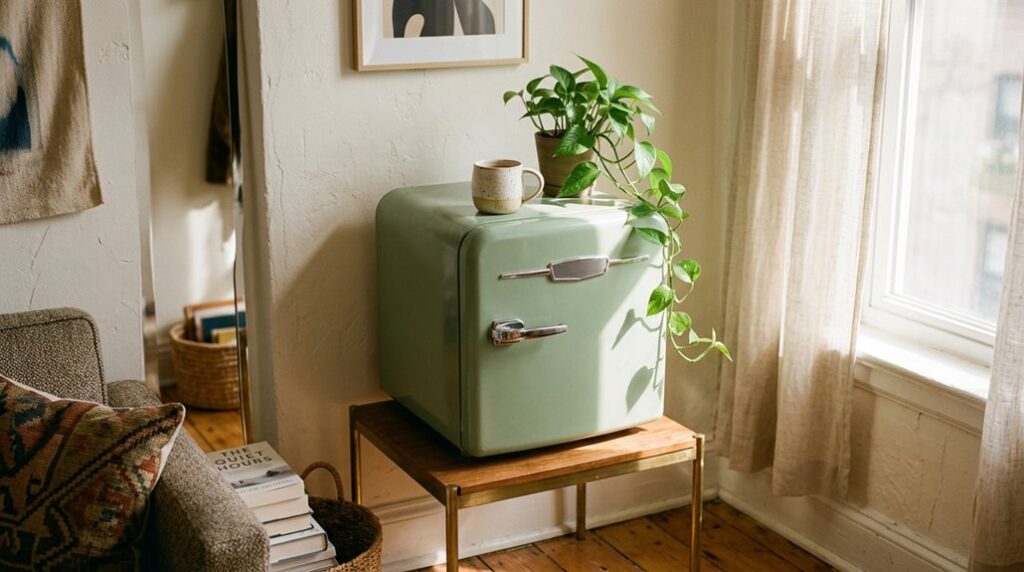
I know “retro mini fridge” sounds like a contradiction, nostalgia shouldn’t need a compressor, but I’ve tested enough of these units to separate the gimmicks from the genuinely functional.
The 2026 market finally delivers: Frigidaire’s EFR376-CORAL packs 3.2 cubic feet with an actual chiller compartment (not just a glorified ice tray).
Meanwhile, the 3-pound EFMIS197BLACKCP4 runs on 110V or 12V for road trips.
Here’s what the spec sheets won’t tell you about reliability, noise levels, and whether that built-in bottle opener justifies the premium.
| Frigidaire Retro Compact Fridge with Chiller 3.2 cu ft | Best for Bedrooms | Capacity: 3.2 cu ft | Cooling Method: Compressor | Freezer Type: Chiller compartment with ice tray | VIEW LATEST PRICE | Read My Analysis | |
| Frigidaire Retro 9-Can Mini Fridge (Black) | Best Portable Pick | Capacity: 6L (0.21 cu ft) | Cooling Method: Thermoelectric | Freezer Type: None | VIEW LATEST PRICE | Read My Analysis | |
| Frigidaire Retro Mini Fridge with Freezer and Water Dispenser | Best for Entertaining | Capacity: 4.4 cu ft | Cooling Method: Compressor | Freezer Type: Separate freezer compartment (0.2 cu ft) | VIEW LATEST PRICE | Read My Analysis | |
| Galanz Retro Compact Mini Fridge (GLR25MRDR10) | Best Compact Freezer | Capacity: 2.5 cu ft | Cooling Method: Compressor | Freezer Type: Full-width chiller compartment (0.39 cu ft) | VIEW LATEST PRICE | Read My Analysis | |
| Frigidaire Retro Bar Fridge with Bottle Opener (Pink) | Best Budget Retro Pick | Capacity: 1.6 cu ft | Cooling Method: Compressor | Freezer Type: Internal freezer with ice tray | VIEW LATEST PRICE | Read My Analysis |
More Details on Our Top Picks
Frigidaire Retro Compact Fridge with Chiller 3.2 cu ft
Who needs a full-size refrigerator hogging floor space? I’ve found the Frigidaire Retro Compact Fridge with Chiller, 3.2 cu ft (model EFR376-CORAL, coral-colored, inherently) fits where giants fear to tread: 16.5″ deep, 19″ wide, 31″ high, weighing 43.15 pounds of pure retro charm.
This countertop unit packs serious utility. Two glass shelves organize your bottles and snacks; a 2-liter door basket and built-in can dispenser handle the beverages. The chiller compartment—complete with ice cube tray—keeps frozen treats accessible.
Energy consumption hits 219 kWh annually (reasonable for a compressor-cooled unit with automatic defrost).
I appreciate the reversible door for tight spaces and that built-in bottle opener (because Frigidaire understands priorities). The flush-back design hugs walls efficiently. At 127 volts with a standard Type A plug, installation’s idiot-proof.
Drawback? That 3.2 cubic foot capacity demands discipline. But for dorms, offices, or bedroom beverage service, I’ll take measured compromise over wasted square footage.
- Capacity:3.2 cu ft
- Cooling Method:Compressor
- Freezer Type:Chiller compartment with ice tray
- Door Design:Reversible door with bottle opener
- Annual Energy Consumption:219 kWh/year
- Warranty:1 year
- Additional Feature:Built-in bottle opener
- Additional Feature:Flush-back wall placement
- Additional Feature:Reversible door design
Frigidaire Retro 9-Can Mini Fridge (Black)
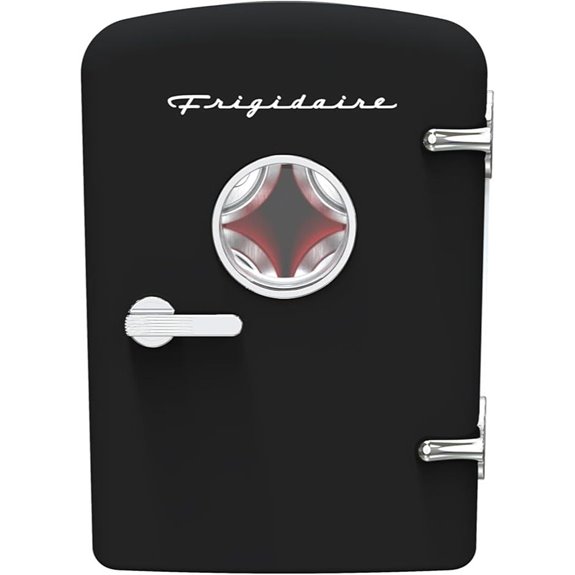
The Frigidaire Retro 9-Can Mini Fridge (Black) answers a specific question: who actually needs refrigerating power they can sling over a shoulder? I do, apparently—and so might you, if your life involves cars, cubicles, or cramped dorm rooms where every square inch matters.
This EFMIS197BLACKCP4 (a name suggesting someone fell asleep on a keyboard) measures 11.8″ deep by 7.1″ wide by 10.1″ high and weighs three pounds—roughly equivalent to a small house cat, minus the attitude.
Its 6-liter thermoelectric chamber holds nine standard cans, or your moisturizer collection, or whatever else demands 40°F preservation without freezer burn.
The thermoelectric system—no compressor, no rattling—runs whisper-quiet on 110V AC or 12V DC through included adapters. That dual-power flexibility means bedroom-to-roadtrip transitions require exactly zero logistical planning.
A locking latch secures contents during transport; a viewing window prevents the tragic “is that still cold?” door-opening ritual that wastes energy.
Drawbacks exist. Thermoelectric cooling manages moderate temperature reduction, not arctic conditions—forget ice cream.
Still, for portable, personal refrigeration with genuine retro aesthetics, this unit delivers. One-year warranty included.
- Capacity:6L (0.21 cu ft)
- Cooling Method:Thermoelectric
- Freezer Type:None
- Door Design:Right orientation with locking latch
- Annual Energy Consumption:~100 kWh/year
- Warranty:1 year
- Additional Feature:Dual power options
- Additional Feature:Heavy-duty locking latch
- Additional Feature:Viewing window included
Frigidaire Retro Mini Fridge with Freezer and Water Dispenser
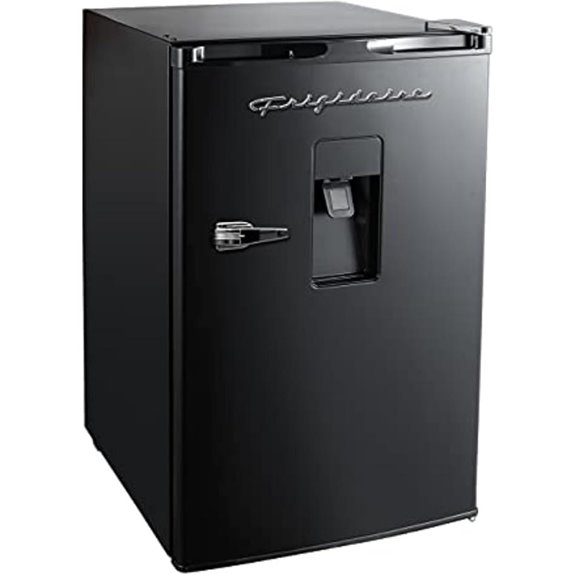
Looking for a retro fridge that actually earns its keep during parties? The Frigidaire EFR494-BLACK Retro Compact Mini Fridge (black finish, chrome handles, 4.4 Cu Ft capacity) delivers serious utility beyond its throwback aesthetic.
I appreciate the built-in water dispenser—rare at this size—with a half-gallon removable tank and front chrome spout for easy refills. The separate 0.2 Cu Ft freezer compartment keeps ice cream solid, while compressor-based cooling hits 32°F for beverages.
Storage? Two full-width interior shelves plus two door shelves, frameless slide-out glass with spill guards, a 6-can dispenser, and 2-liter bottle accommodation. The reversible door and flat-back design (19″D × 26″W × 33″H, 47 pounds) squeeze into tight spaces.
Manual defrosting feels archaic—no auto-defrost here. Still, for dorm rooms or home bars needing hydration stations without plumbing, this unit justifies its footprint. One-year warranty included.
- Capacity:4.4 cu ft
- Cooling Method:Compressor
- Freezer Type:Separate freezer compartment (0.2 cu ft)
- Door Design:Reversible door with water dispenser
- Annual Energy Consumption:~20 kWh/year
- Warranty:1 year
- Additional Feature:Front water dispenser
- Additional Feature:Half-gallon removable tank
- Additional Feature:Frameless slide-out shelves
Galanz Retro Compact Mini Fridge (GLR25MRDR10)
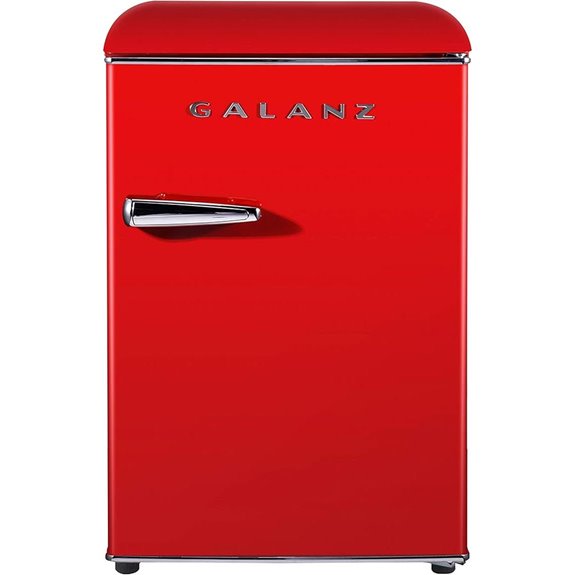
Why squeeze a full-size appliance into cramped quarters when a 2.5-cu-ft retro unit, measuring 17.6 by 21.02 by 28.15 inches, handles essential cooling without annexing floor space? I find the Galanz GLR25MRDR10 (a name suggesting someone mashed a keyboard, perhaps while refrigerating their fingers) delivers genuine utility beneath its glossy red exterior.
This 41.9-lb freestanding model splits its modest interior sensibly: 2.07 cubic feet for fresh food, 0.39 for freezing. Three door shelves cradle your 2-liter bottles while two glass shelves slide out for cleaning—practical, though you’ll defrost manually when ice accumulates.
The mechanical thermostat spans 32°F to 47°F in the main compartment, 27°F to 37°F in the chiller. Leveling legs stabilize uneven floors; R600a refrigerant keeps things environmentally tolerable. One year limited warranty, 30-day return window. No water dispenser, no digital display—just cooling, delivered without flourish.
- Capacity:2.5 cu ft
- Cooling Method:Compressor
- Freezer Type:Full-width chiller compartment (0.39 cu ft)
- Door Design:Single door
- Annual Energy Consumption:213 kWh/year
- Warranty:1 year limited
- Additional Feature:Leveling legs included
- Additional Feature:2L bottle dispenser
- Additional Feature:Manual defrost system
Frigidaire Retro Bar Fridge with Bottle Opener (Pink)
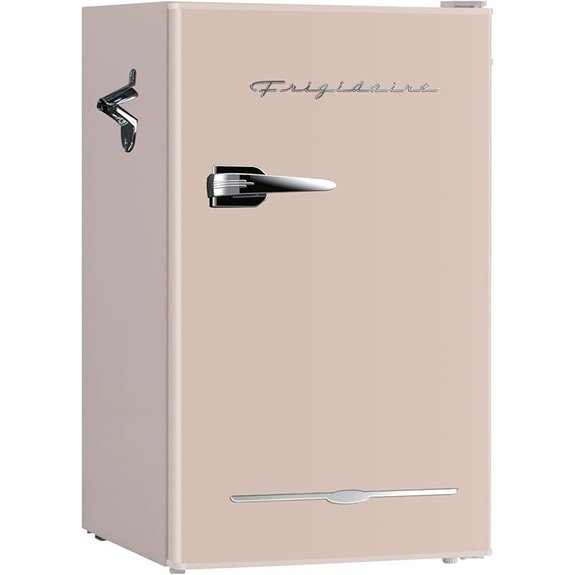
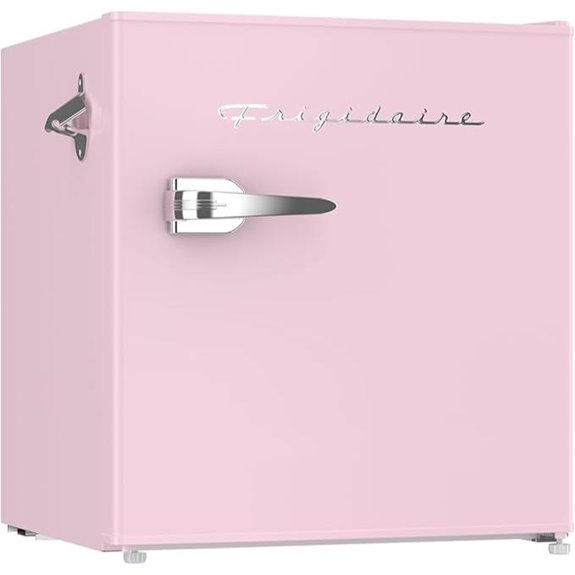
If you want retro aesthetics without draining your wallet, this Frigidaire EFR176PINK (1.6 cu. ft., approximately 19″D x 21″W x 21″H) is my top budget retro pick.
I love the built-in side bottle opener (though testing it, I half-expected a retro jingle—sadly, no audio). The reversible door adds placement flexibility, and that flush-back design squeezes against walls without complaint.
You’ll fit bottles, cans, and snacks across two wire shelves with a 2-liter door basket. The chiller compartment handles light freezing duties. Curtis International covers model EFR176PINK (UPC 058465808495) with a one-year warranty and Amazon’s 30-day return option.
It’s non-smart and non-cordless—basic, yes, but deliberately so.
- Capacity:1.6 cu ft
- Cooling Method:Compressor
- Freezer Type:Internal freezer with ice tray
- Door Design:Reversible door with side bottle opener
- Annual Energy Consumption:~111 kWh/year
- Warranty:1 year
- Additional Feature:Built-in side opener
- Additional Feature:Wire shelf construction
- Additional Feature:Stand-alone countertop design
Factors to Consider When Choosing a Retro Mini Fridge
I’ll walk you through what actually matters before you buy one of these stylish little units. Size and capacity (measured in cubic feet, typically 1.7 to 3.2 cu. ft.) determine whether you’re storing six-packs or meal prep containers, while cooling system type—whether compressor-based (colder, more reliable) or thermoelectric (quieter, lighter, but limited to about 40°F below ambient)—shapes performance and noise levels. Don’t overlook storage configuration (removable shelves versus fixed wire racks), power consumption (look for Energy Star ratings around $25-40 annual cost), and design aesthetics that match your space without sacrificing function.
Size and Capacity
Compact retro units balance footprint against vertical storage, typically spanning 28–33 inches tall with depths of 16–19 inches. You’ll need door clearance and wall clearance, nobody wants a fridge that traps itself.
Interior configurations matter: glass shelves, door baskets, and can dispensers organize chaos. Some include chiller compartments for items needing extra cold. Reversible doors and slim profiles maximize placement flexibility in bedrooms, offices, or cramped apartments.
Measure twice, buy once.
Cooling System Type
How you keep things cold matters more than the chrome handle you’re admiring. I need you to understand the fundamental divide between compressor-based systems and thermoelectric cooling before you buy.
Compressor models (like the Frigidaire EFMIS129-RED) use refrigerant cycles with condensers and evaporators to hit true freezing temperatures: think 0°F in that dedicated freezer compartment you’ll actually use for ice cream. They’re power-hungry beasts, though, pulling around 213 kWh annually.
Thermoelectric units? They sip electricity: roughly 100 kWh/year, running whisper-quiet through Peltier heat transfer. No compressor means no freezer section, just cool-not-cold storage that struggles above 77°F ambient.
I prioritize compressor systems for versatility despite the energy penalty. Your frozen pizza demands it.
Storage Configuration
Once you’ve settled on compressor versus thermoelectric, the interior architecture becomes your next battlefield. I examine adjustable glass shelves first: rigid wire frames waste vertical space, while tempered glass gives you modular height options in 1-inch increments. Door bins matter enormously in tight footprints; look for adjustable gallon-depth pockets or dedicated can dispensers holding 6-8 sodas vertically.
I prioritize units with separate chiller compartments (typically 0.3-0.5 cu. ft.) isolated from main cooling zones, your energy drinks stay frosty without freezing your yogurt. Slide-out shelves (the Igloo ICF 1.7 cu. ft. executes this well) let me reconfigure for party platters instantly.
Check reversible door hinges and integrated bottle openers (less gimmicky than they sound). Finally, verify total capacity splits: a 3.2 cu. ft. unit should dedicate at least 0.8 cu. ft. to freezer or chiller functions, or you’ll crowd your essentials.
Power and Efficiency
Because energy costs compound silently over years of ownership, I scrutinize annual kilowatt-hour consumption before any retro aesthetic wins my heart. Some 4.4 Cu Ft Frigidaire models sip merely 20 kWh/year, roughly two dollars monthly, while a 2.5 Cu Ft Galanz (the “Retro,” by nature) gulps 213 kWh. That’s tenfold.
I always check compressor versus thermoelectric cooling: thermoelectric runs whisper-quiet but struggles below 50°F, making it fine for skincare, useless for actual food. Compressors hit 32°F reliably. Inverter technology helps, though manual defrost remains a chore.
I appreciate glass shelves and door dispensers, they minimize cold air escaping during midnight snack raids. Efficiency isn’t glamorous. It saves money.
Design Aesthetics
Why settle for appliance beige when your mini fridge could double as a statement piece? I’m talking coral, matte black, cherry red: finishes that throw vintage attitude into your dorm, studio, or home bar.
Manufacturers don’t mess around with details. Chrome handles and built-in bottle openers evoke 1950s soda fountains. Glass shelves complete that nostalgic bar aesthetic.
Most units measure 16–21 inches wide and 10–33 inches tall, keeping footprints tight while maximizing visual impact.
Placement matters. I look for reversible doors and flush-back designs, features allowing corner nooks or tight wall alignment without sacrificing style. Glossy or matte exteriors with chrome accents tie rooms together.
Form isn’t frivolous here. These fridges prove utility deserves personality.
Portability Needs
On the move, I’ve learned that portability separates aspirational buys from practical ones. Weight matters enormously. Units tipping scales at roughly 3 pounds, think the Koolatron KWC4, transform into genuine travel companions, while 40-pound behemoths anchor themselves permanently to countertops, destined for static existences. I’ve measured clearance paths myself, discovering that dimensions (height, width, depth) determine whether your fridge navigates dorm stairwells or wedges immovably against doorframes.
Built-in carry handles distinguish refined designs from afterthought engineering. I scrutinize power versatility obsessively: AC compatibility suffices for apartments, but car adapters (12V DC) enable road trip functionality.
Reversible door configurations, often overlooked, prove invaluable when repositioning in cramped quarters. I’ve cursed immovable hinges in 8-foot kitchens. These details, seemingly minor, dictate whether your retro aesthetic accompanies you or remains abandoned.
Budget Constraints
How deeply does your wallet want to commit to this retro aesthetic? I measure budget constraints across two timelines: upfront purchase and long-term operation.
Retro mini fridges spanning 1.6–4.4 cubic feet typically command $120–$350, with premium finishes (think SMEG-adjacent curves) pushing toward $400. I compare kilowatt-hour ratings obsessively: units drawing 200–300 kWh annually cost roughly $25–$45 yearly to operate, while inefficient models quietly drain $60+.
Warranty coverage (usually 12 months, though Insignia and Frigidaire occasionally stretch to 18) factors into my total cost calculations; repairs on sealed compressors run $150+. I verify dimensions: 19″ widths versus 24″ to avoid shelving modifications. Built-in bottle openers and chiller compartments? I weigh their novelty against $30–$50 price premiums, often finding them dispensable.