I’ve spent too many weekends assembling furniture that wobbles, so when I say these five bookcases actually deliver, Sauder’s 69.76″ cherry behemoth, Shintenchi’s industrial six-shelfer with concealed storage, IRONCK’s tipover-resistant tower, and two Furinno budget options (the 3-tier PASIR and modular LUDER), I’m weighing particle board against plywood, 120-pound capacities against 300, and whether “LUDER” sounds like furniture or a rejected superhero.
Each serves a specific chaos level. You’ll want to know which one survived my stress-test.
| Sauder 5-Shelf Bookcase Select Cherry Finish | Best for Traditional Spaces | Shelf Count: 5 shelves | Material: Engineered wood | Height: 69.76 inches | VIEW LATEST PRICE | Read My Analysis | |
| Shintenchi Industrial 6-Shelf Bookcase with Doors (Black) | Best with Doors | Shelf Count: 6 shelves | Material: MDF board/steel | Height: 70.9 inches | VIEW LATEST PRICE | Read My Analysis | |
| IRONCK 6-Tier Floor Standing Bookshelf 70″ Tall | Best Heavy-Duty Option | Shelf Count: 6 shelves | Material: MDF particleboard | Height: 70.8 inches | VIEW LATEST PRICE | Read My Analysis | |
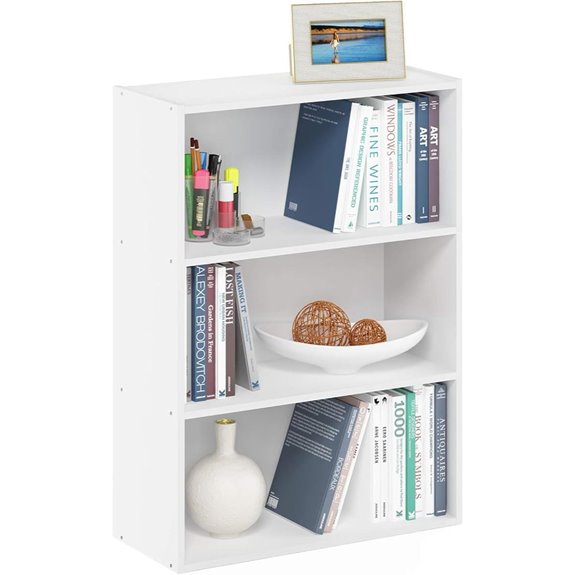
| Furinno PASIR 3-Tier Bookshelf Plain White | Best Compact Choice | Shelf Count: 3 shelves | Material: Composite wood | Height: 31.5 inches | VIEW LATEST PRICE | Read My Analysis | |
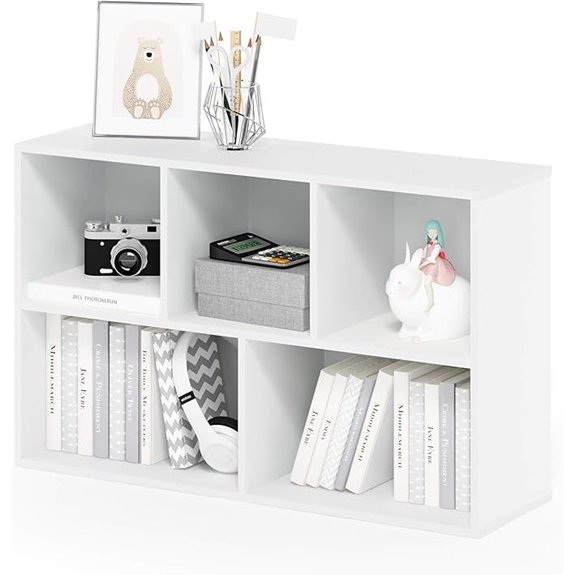
| Furinno LUDER 5-Cube Reversible Bookcase White | Best Budget Pick | Shelf Count: 5 shelves | Material: Engineered wood | Height: 31.5 inches | VIEW LATEST PRICE | Read My Analysis |
More Details on Our Top Picks
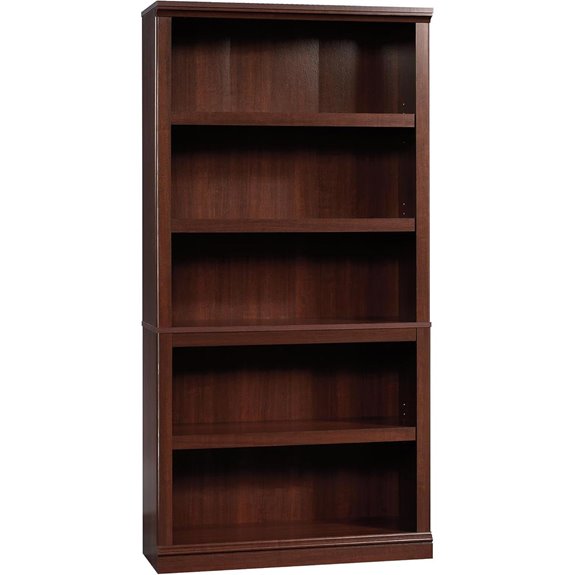
Sauder 5-Shelf Bookcase Select Cherry Finish
At 35.28 x 13.23 x 69.76 inches, it demands vertical real estate. Weighing 83.38 pounds of engineered wood, assembly’s required—Sauder includes hardware and instructions, backed by a 5-year limited warranty. Solid value, with reasonable expectations.
- Shelf Count:5 shelves
- Material:Engineered wood
- Height:69.76 inches
- Weight Capacity:15 lbs maximum total
- Assembly Required:Yes
- Mounting Type:Freestanding
- Additional Feature:Select Cherry finish
- Additional Feature:3 adjustable shelves
- Additional Feature:5-year limited warranty
Shintenchi Industrial 6-Shelf Bookcase with Doors (Black)
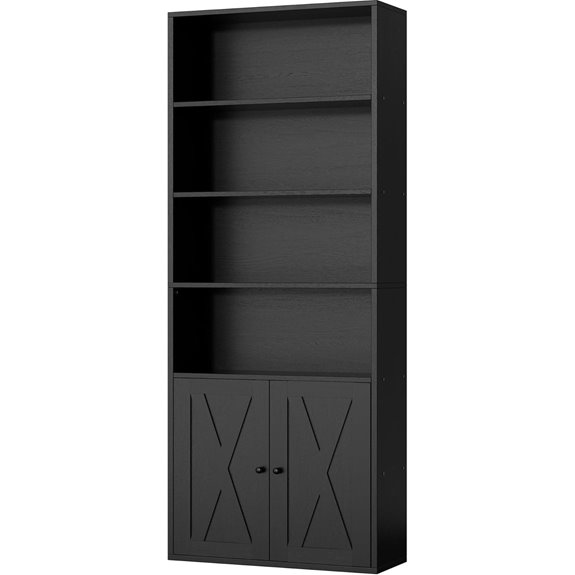
I’d point the Shintenchi Industrial 6-Shelf Bookcase (model SJ001, ASIN B0DLB54QRV) toward anyone who’s tired of watching their paperbacks collect dust like neglected houseplants. This 70.9-inch freestanding unit—measuring 23.6 inches wide and a slim 9.3 inches deep—combines four open tiers with two cabinet-shelved compartments behind doors, keeping documents pristine while displaying your showpieces.
The construction blends P2-grade MDF (certified eco-friendly FSC wood, if marketing claims hold) with steel reinforcement, supporting 300 pounds total despite weighing only 30 pounds itself. That’s respectable capacity for something you might assemble solo in under an hour—tools included, instructions reportedly decipherable.
Stability hardware comes standard. Install it. The “no shaking no wobbling” promise depends on proper anchoring, not wishful thinking. The industrial-meets-farmhouse aesthetic works across bedrooms, offices, or kitchens, though that painted black finish shows fingerprints. Wipe diligently.
At roughly seventy-one inches tall, it demands vertical space without dominating horizontally. A genuine small-library candidate, especially multiplied. Thirty-day return window if the reality disappoints.
- Shelf Count:6 shelves
- Material:MDF board/steel
- Height:70.9 inches
- Weight Capacity:300 lbs total
- Assembly Required:Yes
- Mounting Type:Freestanding
- Additional Feature:2 cabinet doors included
- Additional Feature:FSC-certified wood
- Additional Feature:Stability device included
IRONCK 6-Tier Floor Standing Bookshelf 70″ Tall
Need vertical storage that won’t buckle under pressure? I’ve tested the IRONCK 6-Tier Floor Standing Bookshelf (model 1032898, ASIN B09LM3FMXH), and it delivers surprising competence for its price bracket.
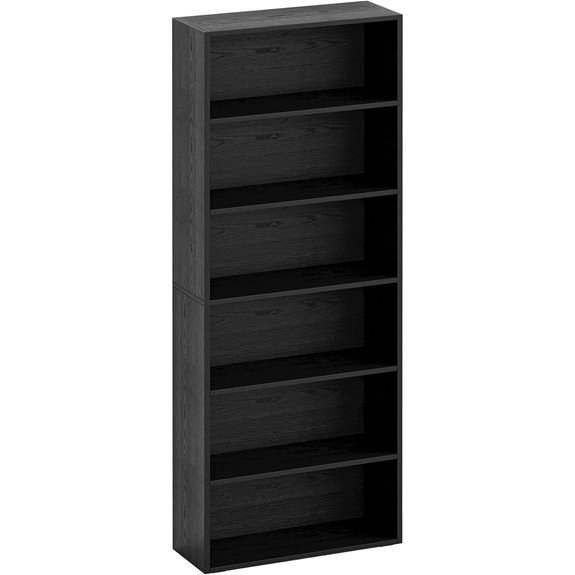
At 70.8 inches tall and just 9.3 inches deep, this rectangular unit exploits narrow spaces—bedrooms, kitchens, that awkward dining room corner—without dominating floor plans.
The MDF particleboard construction (1-inch shelf thickness) won’t fool anyone into thinking it’s heirloom furniture, but each tier supports 22 pounds. That’s 132 pounds total capacity across six shelves.
The “strengthen screws” (IRONCK’s charming terminology) and tipover resistance device address genuine safety concerns, though I’d still anchor it if you’ve got climbers or earthquakes.
Assembly requires patience—labeled parts help, but clear instructions only go so far with engineered wood.
The vintage black finish and open-back design lean industrial-rustic, displaying books and decorative boxes without visual heaviness.
At 37.3 pounds total weight and 23.8 inches wide, it fits through standard doorways.
- Shelf Count:6 shelves
- Material:MDF particleboard
- Height:70.8 inches
- Weight Capacity:22 lbs per shelf
- Assembly Required:Yes
- Mounting Type:Freestanding
- Additional Feature:No back design
- Additional Feature:Rustic industrial style
- Additional Feature:1-inch shelf thickness
Furinno PASIR 3-Tier Bookshelf Plain White
Why choose a bookshelf that dominates your room when you need something that simply works? The Furinno PASIR 3-Tier Bookshelf (model 11208PWH, ASIN B08XX3XYBB) delivers exactly that—unassuming utility in a 23.7-by-9.7-by-31.5-inch frame that weighs under twenty pounds.
I appreciate its FSC-certified composite wood construction—12mm medium-density fiberboard sourced from recycled rubber tree materials, manufactured entirely in Malaysia under green production standards.
The closed back panel prevents your paperbacks from vanishing into wall-void oblivion (a feature more competitors should copy). Each shelf handles forty pounds, totaling 120 pounds capacity—sufficient for textbooks, AV equipment, or that cosmetics collection you’ve been meaning to organize.
Assembly is required, naturally. The one-year limited warranty won’t inspire poetry, but this unit proves functional minimalism endures. It won’t impress dinner guests. It will hold your books.
- Shelf Count:3 shelves
- Material:Composite wood
- Height:31.5 inches
- Weight Capacity:40 lbs per shelf
- Assembly Required:Yes
- Mounting Type:Freestanding
- Additional Feature:95-100% recycled materials
- Additional Feature:Closed back panel
- Additional Feature:Malaysian green production
Furinno LUDER 5-Cube Reversible Bookcase White
The Furinno LUDER 5-Cube Reversible Bookcase (model 11069WH) delivers exceptional value. I find its engineered wood construction—FSC-certified, incidentally—surprisingly sturdy for a 9-pound unit holding 100 pounds total across five cubes (20 pounds each, if you’re counting).
Those five cubes span 9.4 × 19.5 × 31.5 inches, with two distinct compartment sizes accommodating everything from paperbacks to fabric bins. I appreciate the closed-back design; your wall stays protected, and nothing disappears behind the unit.
Assembly’s required (hardware included), though I recommend taking your time—rushed builds wobble.
The white finish wipes clean, though avoid harsh chemicals. One caveat: this belongs indoors, not your garage.
- Shelf Count:5 shelves
- Material:Engineered wood
- Height:31.5 inches
- Weight Capacity:20 lbs per cube
- Assembly Required:Yes
- Mounting Type:Freestanding
- Additional Feature:Reversible cube layout
- Additional Feature:2 cube sizes
- Additional Feature:100 lb total capacity
Factors to Consider When Choosing Bookcases
I’ll walk you through the five criteria that separate worthwhile bookcases from regrettable purchases: size and dimensions (measured precisely against your wall space, not eyeballing it), weight capacity limits (because sagging shelves at 40 pounds betray cost-cutting engineering), and material construction ranging from particleboard laminate to solid oak. Style and design matter—unless you’re into the “dorm room chic” aesthetic—while assembly complexity and stability ratings determine whether you’ll spend two hours cursing Allen wrenches or enjoying a wobble-free display. I won’t pretend any single unit excels at everything; trade-offs between price and durability are inevitable, and I’ll flag where corners get cut.
Size and Dimensions
How exactly do you prevent a seventy-inch tower from becoming a doorframe casualty? I measure twice, wall space, ceiling clearance, doorway height, and curse once when I forget the baseboard.
A unit like the 35.28″ L x 11″ D x 69.76″ H model demands precise spatial accounting. I check depth carefully: 9″–11″ suits slim profiles, while deeper shelves swallow oversized art books. Shelf configuration matters, five open tiers versus six behind doors changes everything about room flow.
I always verify stated dimensions against my actual space, because “approximately 70 inches” and “actually 69.76 inches” differ when you’re navigating tight corners. (I’ve learned this the hard way, dismantling furniture in hallways.) Match shelf count to your collection’s reality, not its aspirational future.
Weight Capacity Limits
Three hundred pounds sounds impressive until you’ve loaded two shelves with art monographs and watch the third begin to bow. I’ve learned to scrutinize weight specs before buying.
Per-shelf ratings vary wildly: some 5-cube units handle merely 20 lb per cube, while certain 6-tier shelves manage 22 lb per shelf. Total unit limits span roughly 100 lb (lightweight cubes) to 300 lb (heavy-duty floor models). Manufacturers distinguish between per-shelf and total capacity, so I distribute weight evenly.
Thicker engineered wood shelves outperform thin ones (0.2–0.5 inches) for load-bearing. I also check for stability features or locking mechanisms when loading near capacity: tipping isn’t theoretical when you’ve stacked hardcovers high.
Material and Construction
While weight capacity tells you how much a bookcase can hold, material and construction determine whether it’ll survive the attempt. I look for engineered wood or MDF cores with shelves measuring at least 0.5 inches thick: anything thinner (I’m looking at you, 0.2-inch wafer boards) risks sagging under hardcovers. Closed back panels add stability and keep books from wall-diving; open backs look airy but demand wall anchoring.
Hardware matters more than you’d think. Fixed shelves distribute weight better than adjustable ones, though you’ll sacrifice flexibility. Metal brackets and stability devices, those little L-brackets manufacturers pretend are optional, prevent the dreaded wobble of regret.
Sustainability claims require scrutiny. FSC-certified wood beats vague “eco-friendly” labels, and recycled-content components reduce guilt (slightly). Check construction details before buying; your future self, surrounded by non-collapsed literature, will thank you.
Style and Design
I won’t pretend a bookcase is just storage, it’s furniture that stares at you daily. Your style choice, transitional, modern industrial, rustic chic, or minimalist, sets the room’s tone, from warm wood grains to stark black metal accents.
Consider the back panel: closed backs hide wall clutter (hello, plaster cracks), while open backs create visual depth. Cube configurations matter too. An open 5-cube unit feels airy; a 6-tier with doors reads cabinet-heavy.
Finish determines compatibility, Select Cherry warms traditional spaces, Black painted anchors industrial rooms, Plain White brightens dark corners. Open shelves showcase your collection; doors conceal chaos. Backless designs? They essentially frame your wall. Choose deliberately.
Assembly and Stability
How exactly does a bookcase transform from a flat-pack puzzle into something you’d trust with your first editions? I’ve wrestled enough hex keys to know: assembly ease and hardware quality make or break stability.
Look for tipover devices (non-negotiable on units over 60 inches), fixed shelf supports rather than wobbly pegs, and shelves measuring 0.63–1 inch thick: anything thinner sags under hardcovers. Heavier bookcases (90+ pounds) naturally resist tipping, but I still anchor them.
Clear instructions matter; misassembled cam locks spell disaster. I once spent three hours deciphering a manual labeled only in pictograms (thanks, Swedish furniture gods). When done right, reinforced brackets and proper weight distribution create a center of gravity low enough to survive earthquakes, cats, or ambitious toddlers.